Yoga for Soccer Players: The Science Behind Recovery, Breath, and Peak Performance
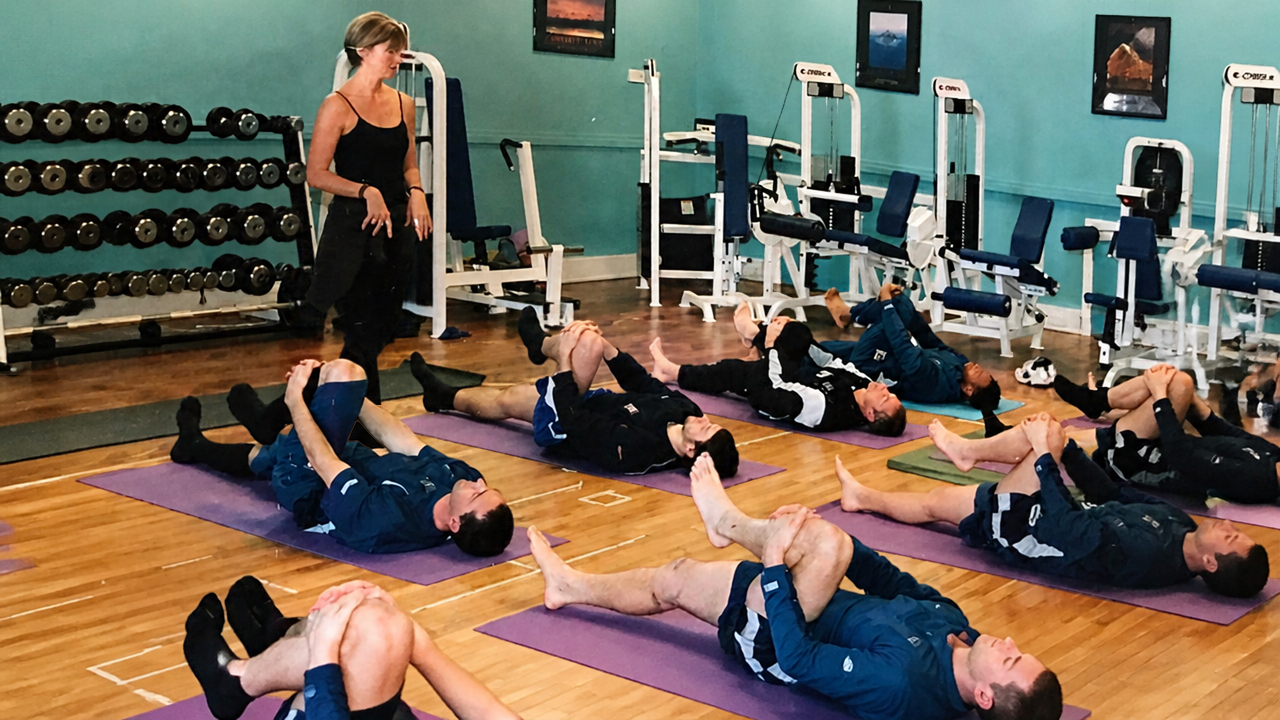
Hayley Winter teaching sport-specific yoga at Ipswich Town Football Club, UK, in 2002.
Written by Hayley Winter | 2026
Back in 2003, I was invited to present at the England Football Association's annual training conference. The event focused on the latest advances in performance training, and I was there because of some results that had caught people's attention.
The squad of players I'd been working with had one of the smallest rosters in the league. They couldn't afford injuries. And that season, they didn't have any. They played the entire season injury-free.
When they were asked about their secret, they credited yoga as their only new intervention.
Of course, one injury-free season doesn't prove that yoga prevented injuries. But the players' experience raised some interesting questions about what yoga might contribute to athletic preparation.
That moment stayed with me.
When the FIFA World Cup kicked off in June 2026, the pressure on these players was intense. Representing your country is an enormous honour, and performance nerves can run at full stretch.
Having spent nearly 30 years working in Yoga Sports Science, with my career starting in football, I've seen how yoga can contribute to the preparation of players at different levels of the game.
But when a player is on the brink of possibly the biggest match of their life, the question becomes more specific.
What does that player actually need from yoga at this stage of competition?
The answer might surprise you.
What Soccer Players Actually Need During the World Cup
Less is more.
The hardest physical preparation is behind them. Now the focus shifts towards recovery, maintaining readiness and preparing for the next match.
The nervous system has an important role to play here.
Players need to manage their energy, attention and emotional responses while remaining physically ready to perform.
And that's where appropriately selected yoga practices may have something valuable to offer.
Based on seven years of case-study research at the Institute of Yoga Sports Science®, alongside my experience working with athletes, I've found that the timing and purpose of a yoga session matter enormously.
At this stage of competition, restorative time on the mat, gentle breathwork and comfortable mobility work may be more appropriate than a demanding physical session.
There's little reason to introduce challenging vinyasa flows or unfamiliar dynamic sequences immediately before an important match.
The aim is to complement the player's existing preparation, not add unnecessary physical or mental demands.
When players have opportunities to settle their attention, reconnect with their bodies and become more aware of their breathing, they may feel better prepared to approach the game with confidence and composure.
And sometimes, the simplest practices are the most useful.

Breath and Body Temperature: What Yoga Can Offer Players in the Heat
For players from England, Scotland and other countries less accustomed to competing in hot conditions, the environment adds another layer of demand.
The body works harder to regulate its temperature. Fatigue can develop more quickly, particularly when heat is combined with prolonged physical effort.
Managing these conditions requires careful preparation, including heat acclimatisation, hydration, appropriate recovery and established cooling strategies.
But what about breathing?
Yoga has a long tradition of exploring how breathing influences our physical and mental state.
One technique, known as Sitali Pranayama, is traditionally associated with a cooling sensation.
The technique is simple.
The practitioner gently curls the sides of the tongue, inhales slowly through it as though drawing air through a straw, and then exhales comfortably.
For those who cannot curl their tongue, variations can be explored without forcing the movement.
The sensation of cool air passing over the tongue can be refreshing, and the slow, deliberate nature of the practice offers an opportunity to direct attention towards the breath.
It's important, however, to distinguish the sensation of cooling from a measurable reduction in core body temperature.
Although research has explored how certain breathing and meditation practices influence temperature regulation, there isn't sufficient evidence to conclude that Sitali breathing reduces heat strain or improves football performance in hot conditions.
For players, its potential value may lie in offering a familiar moment of calm, body awareness and focused breathing.
It could be practiced briefly in a changing room or during a quiet period of preparation, provided the player finds it comfortable and has learned the technique beforehand.
For yoga teachers working with players, this is an important distinction.
Introduce breathing practices early, allow athletes to become familiar with them and consider how they fit within the wider preparation programme.
Breathwork should never replace appropriate hydration, heat acclimatisation or medical and performance-team guidance.
But as a simple way of encouraging awareness and helping a player settle before competition, the breath is always worth considering.
Yoga for Soccer Players: Where to Start
If you're a yoga teacher wanting to work with soccer players, or a coach looking to integrate yoga into an athlete's training programme, the principles are the same.
Keep it short. Keep it specific. And always connect what you're teaching to the needs of the player in front of you.
A yoga session for a player recovering from a demanding match will look different from one designed to support movement preparation during pre-season.
The athlete's training load, injury history, experience of yoga and immediate sporting demands all influence what might be appropriate.
This is where understanding the science of movement becomes especially valuable.
It helps us move beyond simply choosing yoga poses and begin designing sessions with a clear purpose.
A Free Guide for Yoga Teachers
If you'd like to explore this further, I've put together a free guide:
How to Teach Yoga to Soccer Players
It brings together ten insights from my experience working with athletes and introduces some of the considerations that make teaching yoga within sport different from teaching a general yoga class.
Take Your Teaching Further
Yoga for Soccer Sequence
A ready-to-teach session designed around the movement and preparation needs of soccer players, with a practical framework you can adapt to different abilities and training environments.
Explore the Yoga for Soccer Sequence
Yoga for Athletes: 40-Hour Online Course
For yoga teachers and movement professionals who want to develop a deeper understanding of sport-specific yoga, this course brings together movement science, teaching methodology and practical application.
Explore the 40-Hour Yoga for Athletes Course
The more we understand the athlete, the more thoughtful our teaching can become.
And whether we're working with a professional footballer preparing for a World Cup match or someone playing for their local club, that principle remains the same.
Start with the player. Understand the demands. Then decide where yoga can help.
About Hayley Winter
Hayley Winter (MSc, BWY Dip, ERYT-500, YACEP) is the Founder of the Institute of Yoga Sports Science® and Co-founder of the School of Yoga Sequencing.
Her work brings together yoga, biomechanics and sports science, with a particular focus on developing and teaching sport-specific yoga for athletes.
Her early career included working with professional football clubs, including Ipswich Town FC and Southampton FC. In 2005, Sir Clive Woodward invited Hayley to work with Southampton FC, where her work included members of the squad such as Gareth Bale.
Through the Institute of Yoga Sports Science®, Hayley has spent more than a decade educating yoga teachers, physiotherapists and movement professionals interested in applying yoga within sporting environments.
Research and Further Reading
1. Institute of Yoga Sports Science®
Winter, H. Yoga Sports Science® case-study research.
Seven years of case-study research investigating the application of sport-specific yoga within athletic training. This work informs the YSS teaching methodology and should be understood as practice-based research rather than definitive evidence of injury prevention or performance improvement.
2. Kozhevnikov, M., Elliott, J., Shephard, J. and Gramann, K. (2013)
Neurocognitive and Somatic Components of Temperature Increases during g-Tummo Meditation: Legend and Reality.
PLOS ONE, 8(3), e58244.
This study examined temperature increases associated with g-tummo meditation. It provides an example of scientific investigation into breathing, meditation and temperature regulation, but it does not establish that Sitali breathing cools the body or improves sporting performance.
Research note: The scientific evidence for cooling breathwork in competitive football remains limited. The breathing technique described here is presented as a traditional yoga practice that may support subjective comfort and attention, rather than a proven method of reducing heat strain.
