Before Zoom, Before COVID: How We Took Yoga Education Online.

Originally published 2019 · Written by YSS Founder Hayley Winter
Editor's Note | Looking Back from 2026
When I first wrote this article in January 2019, online yoga education was still finding its feet.
Little did any of us know that just over a year later, a global pandemic would close yoga studios, universities, gyms and training centers around the world. Teachers who had spent their careers working face-to-face suddenly had to learn how to teach through a screen.
For us at the Institute of Yoga Sports Science® (YSS), the situation was different.
We had already been teaching online for more than a decade.
And the journey that got us there began with another global crisis.
How it all began
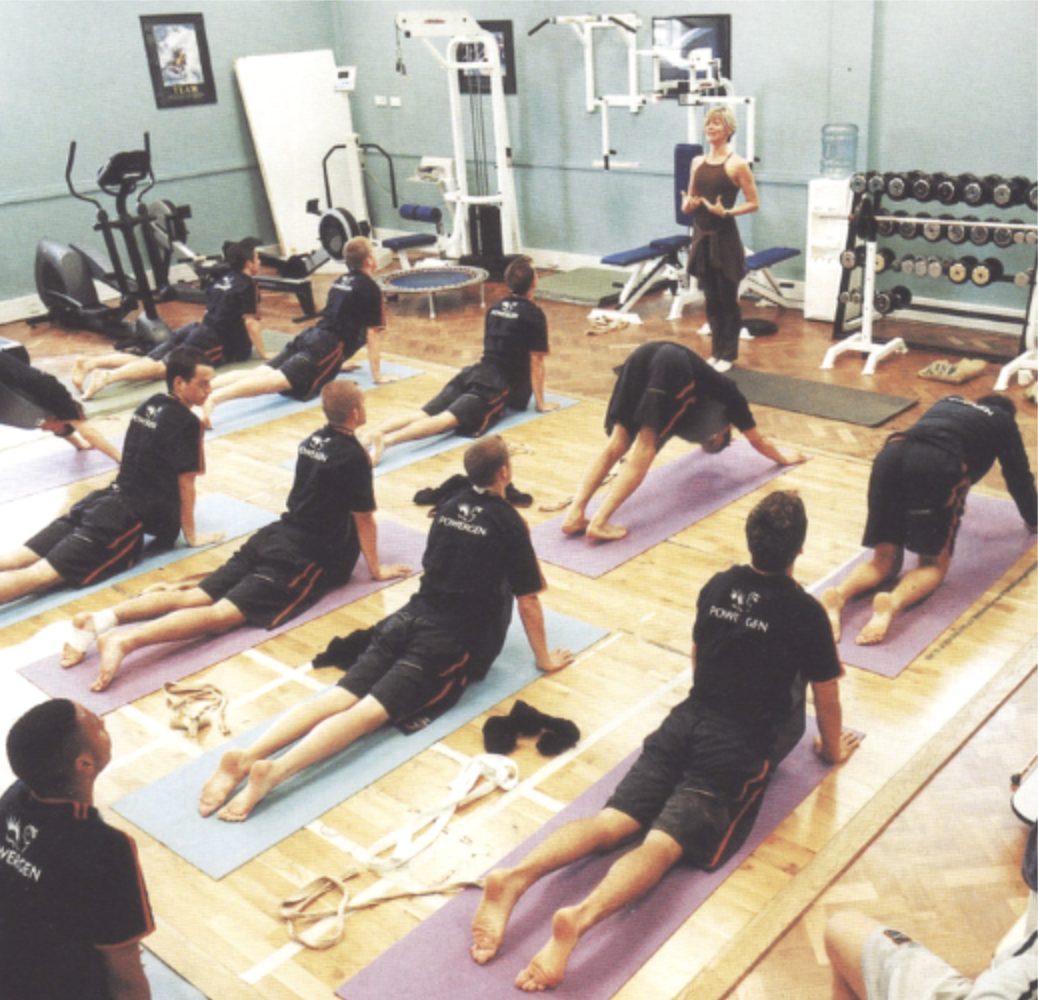
Teaching a sports-specific yoga session at Ipswich Town FC, UK, 2001
My interest in yoga for athletes began long before online education became part of the picture.
From around 2000, I had been exploring a hypothesis: could yoga be adapted specifically to support athletic performance?
I began putting that question into practice through my work with athletes and sporting organisations, including the English Institute of Sport, now the UK Sports Institute, The English Football Association and athletes from a range of sporting disciplines.
Over time, I developed a sport-specific yoga methodology that could sit alongside an athlete's existing strength and conditioning programme.
Demand grew.
And it became increasingly clear that if this work was going to reach more athletes, I needed to train other yoga, health and fitness professionals to deliver it.
My background included higher education syllabus development, so I began building a structured course that could train professionals in the methodology that became Yoga Sports Science®.
In 2008, the first live YSS training began.
Students travelled from around the UK to attend. Applications were coming in for future courses and, after years of developing the methodology, it finally felt as though everything was falling into place.
Then the global financial crisis hit.
When circumstances force you to rethink the plan
Towards the end of 2008, students began contacting me.
They still wanted to train, but circumstances had changed. People were losing jobs. Household finances were under pressure. And the additional cost of travelling and finding accommodation made attending the course increasingly difficult.
I had a decision to make.
I could postpone the training and wait for the economy to recover.
Or I could find another way.
So I went back to the students and asked a simple question.
If I could find a solution that meant they didn't need to travel, would they still want to do the course?
The answer was a resounding yes.
There was just one rather significant problem.
How on earth was I going to teach yoga education online?
Could you really teach yoga through a screen?
Today, that question probably sounds rather strange.
In 2009, it didn't.
There was no established blueprint for delivering professional yoga education online. I couldn't simply ask other yoga educators how they were doing it.
So I started asking much bigger questions.
How important is the physical proximity of teacher and student?
How do you create meaningful relationships between students, peers and tutors when they're not in the same room?
How should practical teaching skills be assessed?
How could we determine whether a student could take what they had learned and apply it appropriately with a real athlete?
And perhaps most importantly, could yoga move into a virtual learning environment without losing something essential in the process?
These weren't really questions about technology.
They were questions about education.
And that distinction became important.
Building an online course before online courses were the norm
Rather than trying to recreate a classroom on a computer, I began thinking about what students actually needed in order to learn well.
My experience crossed several different worlds.
I had a background in yoga teaching and higher education, alongside a degree in graphic design and animation and experience working as a technical engineer.
Suddenly those seemingly unrelated skills became extremely useful.
With the support of friends and colleagues, we began building an online learning environment around the student.
The technology would inevitably change. The educational principles needed to be much more robust.
Students needed access to tutors.
They needed opportunities to discuss, question and reflect.
They needed clear learning resources.
And because this was professional training, they needed a way to demonstrate that they could take theoretical knowledge and successfully apply it in practice.
From knowledge to competency
One of my biggest concerns was assessment.
Watching a lecture or completing an assignment could demonstrate knowledge. It couldn't necessarily tell us whether someone could work competently with an athlete.
Working with Dr Maggie Bunting, then a senior lecturer in Medical Education at the University of East Anglia, we began developing a way for students to gather meaningful information while working in the field.
I also brought in Tim Newenham, former Performance Director for British Olympic Shooting, GB Javelin Coach and former athlete, to help refine the process for an athletic environment.
This work became the YSS Log Book.
Students used it while working directly with athletes, gathering and recording information as they applied their sport-specific yoga intervention.
Their practical work became part of their case study and assessment.
This meant the online course didn't exist solely online.
Students learned digitally, then took that learning into the real world.
That principle remains important to me today.
Moodle, Skype and DVDs in the post
Looking back, some of the technology now feels wonderfully prehistoric.
We used Moodle as our learning platform.
Citrix webinar software supported group sessions.
Skype allowed us to conduct individual tutorials.
Students uploaded assignments through Moodle.
Video was slightly more complicated.
Some practical work had to be transferred onto DVDs and sent through the post, alongside case studies and YSS Log Books.
There were certainly moments when creating an online yoga education felt considerably harder than simply hiring a room and putting out some mats.
But slowly, we built it.
Teaching videos were supported with graphics and additional lecture material. Students had extensive course resources. Tutor contact was central to the experience, and technical support was available for students who weren't confident online.
Our philosophy was simple:
There is no such thing as a silly question.
Students were encouraged to contact us whenever they needed help.
Because we realized very early that successful online education isn't simply about putting information onto a screen.
It's about creating an environment in which someone can learn.
Ten years later
When I originally wrote this article in January 2019, YSS had been delivering online yoga education for ten years.
By then, many of the concerns I'd had in 2009 had become some of the strengths of the program.
Online tutorials could give students focused time with their tutors.
Group sessions allowed students living in different countries to learn together.
The practical application of Yoga Sports Science® meant students could take their learning away from the screen and directly into their work with athletes.
And our assessment process helped us evaluate not simply what a student knew, but how they applied that knowledge.
Online education had also made the training accessible to people who might never have been able to travel to study with us in the UK.
It had become something much bigger than the solution to a travel problem we'd imagined back in 2008.
Then the world changed.
When the world went online
In 2020, COVID-19 changed the landscape almost overnight.
Studios closed. Training courses were disrupted. Teachers who had spent years working face-to-face suddenly found themselves having to teach through a screen.
Online teaching moved from being an alternative way of working to becoming, for many teachers, the only way they could continue.
For YSS, the situation was very different.
We had already spent more than a decade asking many of the questions that teachers and training organisations were suddenly having to address.
How do you create connection online?
How do you support students when you're not physically in the same room?
How do you assess practical skills and competency?
How do you create opportunities for discussion, feedback and reflection?
And how do you make sure technology supports the learning rather than becoming the learning?
We had made mistakes along the way. We had experimented. We had listened to students and continually adapted.
Through that process, we'd developed best practices around online pedagogy, communication, student support, assessment and practical application.
So when COVID arrived, we weren't starting from scratch.
We were able to draw on those years of experience to support teachers as they navigated the sudden transition to online teaching and learning.
Something that had begun in 2009 as a response to one global crisis became unexpectedly relevant during another.
What more than 15 years of online education has taught me
Technology has changed enormously since we first took YSS online.
But I don't think technology is the most interesting part of this story.
The bigger lesson has been understanding what makes education effective, wherever it happens.
A sophisticated learning platform can't replace good teaching.
A library of videos can't replace meaningful feedback.
And convenience alone doesn't create competency.
Good online education needs intention behind it.
Students need to understand not only what they're learning, but how to apply that knowledge.
They need opportunities to question, practise, reflect and receive feedback.
And when we're training teachers to work with other people's bodies, that becomes even more important.
Yoga has always adapted
One of the conversations I remember having when I was considering taking YSS online was with my long-time yoga teacher, Mikki Marks, who had also taught me during my British Wheel of Yoga teacher training.
We talked about the way yoga has continually evolved and adapted as it has moved through different cultures, communities and generations.
At the time, moving yoga education into a virtual space felt like a considerable stretch.
Looking back now, I see it rather differently.
The medium changed.
The responsibility of the teacher didn't.
Whether we're teaching in a studio, working with an athlete or educating someone on the other side of the world, we still have to ask:
Is this helping the person in front of me learn, understand and apply what we're teaching?
That question has guided YSS since we first went online.
And it still guides our work today.
From an experiment to a global community
What began as a response to the financial crisis became something much bigger.
Moving online allowed people who might never have been able to travel to a UK-based training course to study with us.
Students brought different sporting backgrounds, cultures, professions and experiences into the learning environment.
And every cohort taught us something.
Their feedback helped us refine the course, improve the resources and think more deeply about how sport-specific yoga should be taught.
More than 15 years later, I'm still interested in many of the same questions I was asking in 2009.
How do we educate yoga teachers well?
How do we translate research and movement science into useful teaching practice?
How do we maintain quality as technology and education continue to change?
And how do we give teachers the confidence and skills to take what they learn and apply it meaningfully in the real world?
The technology will continue to evolve.
The platforms will change.
The way people choose to learn will change too.
But perhaps that's the bigger lesson from this story.
Good education isn't defined by whether it happens in a classroom or through a screen.
It's defined by the quality of the teaching, the thinking behind it and what the student is able to do with what they have learned.
When those first students called me in 2008 to say they could no longer afford to travel, I thought I was trying to solve a practical problem.
I didn't know it would fundamentally change the way we taught.
Sometimes circumstances force us to question the way things have always been done.
And sometimes, that question is where the most interesting learning begins.
