Yoga Teacher Credibility: Beyond Instagram Followers
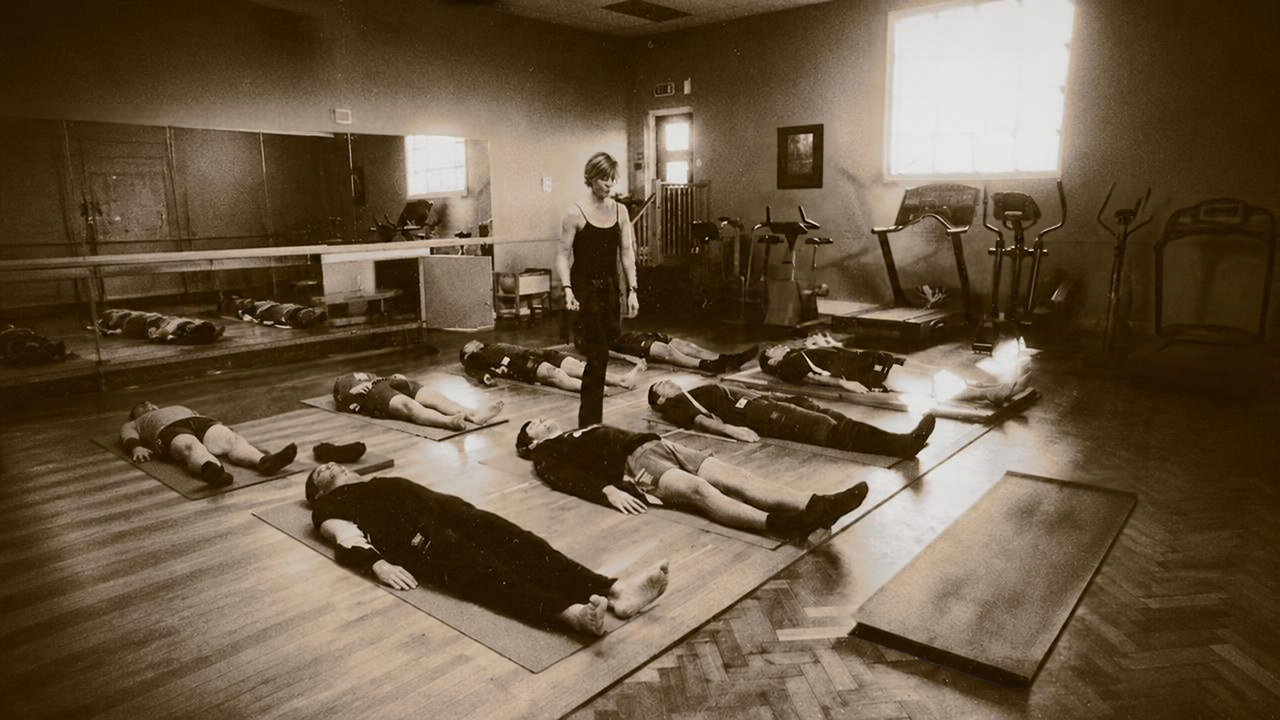
This photograph was taken in 2001, sixteen years before Dr Abby Hoffmann wrote this article. It captures an early chapter in the journey that would eventually lead to the development of Yoga Sports Science®.
Originally published 2017 · Written by Dr Abby Hoffmann
Editor's Note | Looking Back from 2026
When Dr Abby Hoffmann wrote this article in 2017, Instagram yogis were becoming increasingly influential in shaping how yoga was presented and perceived.
Nearly a decade later, social media continues to play a role in the yoga community. But Abby's original question remains just as relevant: what gives a yoga teacher professional credibility beyond their online following?
In this article, Abby explores how evidence-informed teaching, specialist knowledge and an understanding of sports science can help yoga teachers develop the confidence and credibility to work with athletes and within professional sport.
We've revisited her original article while preserving the perspective and historical context in which it was written.
With yoga reaching huge levels of popularity, it seems everyone you meet is either a yoga teacher or training to become one.
But in a world increasingly dominated by picture-perfect Instagram poses and rock-star yogis in colourful leggings, is there a way for yoga teachers to distinguish themselves from the crowd?
At the Institute of Yoga Sports Science® (YSS), the development of the Yoga Sports Science Method® has brought together the traditions and practices of yoga with an approach to movement informed by sports science and research.
But how did we get here, and why does evidence matter when yoga moves into the sporting environment?
YSS faculty member Dr Abby Hoffmann investigates.
From Yoga Tradition to Sports Science
As our previous blog, Yoga Sports Science® and the British Wheel of Yoga: Coming Full Circle, explained, the journey began with a single step.
By answering the call to become a teacher, YSS Founder Hayley Winter began her own process of enquiry into the potential that yoga holds for human development.
As she experienced many of the physical, mental and emotional benefits that yoga could offer practitioners, she also began to question what these practices might offer those working within professional sport.
Hayley’s early work brought her into contact with athletes and professional sporting environments, providing opportunities to explore the application of yoga within sport.
Her fascination with the human body and how it works later led her to postgraduate study in biomechanics at Roehampton University in London. It was through this combination of yoga, movement and sports science that she began to explore more deeply the value that yoga might add to sport-specific training.
Yoga has a long history of observation, practice and enquiry.
Throughout its evolution, teachers and practitioners have explored how different practices affect the body and mind. In the 21st century, scientific research has provided another lens through which some of these effects can be investigated.
At the same time, yoga has continued to move into new environments, including sport, where claims about performance, recovery and physical outcomes increasingly need to be supported by appropriate evidence.
When Sport Asks for Evidence
It could be argued that yoga’s continued popularity reflects the value that many practitioners find in it.
But professional sport asks different questions.
Sport demands data, measurement and evidence. While research into yoga has continued to develop, there can still be a gap between the benefits attributed to yoga and what can be demonstrated through appropriately designed research.
As study designs improve, researchers are increasingly able to investigate specific outcomes and better understand where yoga may have value.
This becomes particularly important when yoga enters professional sport.
Sports science itself is a relatively young discipline. During the Cold War, sporting rivalry between the former Soviet Union and the United States contributed to increasingly sophisticated approaches to athletic training and preparation.
Today, sport is also big business.
Coaches, athletes and support teams are continually looking for ways to improve performance, support recovery and manage the physical and psychological demands placed upon athletes.
Any new training method introduced into this environment therefore needs to have a clear purpose.
Bringing Yoga Into the Athlete’s Environment
Working with athletes is an art as well as a science.
The art lies in understanding the individual: their motivation, attitudes, beliefs and response to training.
The science lies in understanding their movement, the demands of their sport and the context of the environment in which they are training and performing.
This is where the application of yoga to sport needs to become more specific.
Rather than assuming that a general yoga practice will automatically produce a particular sporting outcome, the starting point is the athlete.
What does this individual need?
What does their sport demand from them?
And where might appropriately selected yoga techniques complement the work already taking place within their training programme?
Depending on the athlete and the intended outcome, this might involve exploring movement efficiency, mobility, stability, body awareness, breathing, recovery or strategies for managing focus and performance nerves.
The important point is that the intervention has a reason for being there.
The Yoga Sports Science Method® approaches this by considering the individual first, then the sport-specific demands, before identifying appropriate yoga techniques and considering how they might be integrated into the athlete’s wider training.
Building Professional Credibility
There have never been as many capable and experienced yoga teachers as there are today, and the profession continues to grow.
For teachers who want to work beyond the general yoga environment, particularly with athletes and other specialist populations, passion for yoga may only be the beginning.
Professional credibility also comes from understanding the people you are working with, developing appropriate specialist knowledge and being able to explain the reasoning behind what you teach.
In his 2016 graduate story, How I Found My Groove With Yoga Sports Science®, YSS graduate and keen cyclist Benjamin du Bernard reflected on his training experience. For him, bringing sport and yoga together became part of a much wider learning journey.
That ability to connect yoga with biomechanics, evidence and the specific needs of an athlete can give teachers another way of communicating with coaches, physiotherapists, strength and conditioning professionals and others working within sport.
It can also encourage us to ask better questions about our own teaching.
Why are we choosing this technique?
What are we hoping it will achieve?
And how will we know whether it is helping?
Perhaps this is where the real opportunity lies.
As yoga continues to evolve, credibility will not come from how impressive a pose looks on Instagram. It will come from the quality of our teaching, the questions we are willing to ask and our ability to understand both the possibilities and the limitations of the practices we share.
About Dr Abby Hoffmann
At the time of writing, Dr Abby Hoffmann was Head of Performance Science at the Institute of Yoga Sports Science®. She had spent ten years working in professional dance as an educator and dance scientist. Her PhD research investigated how yoga could support dancers’ wellbeing and mental health, and her work brought together research in dance and movement with the practices and teachings of yoga. She is Founder of the Yantra Academy, and owner of Yantra Studio in Norwich, UK.
