Why a Wobble a Day Is Good for You
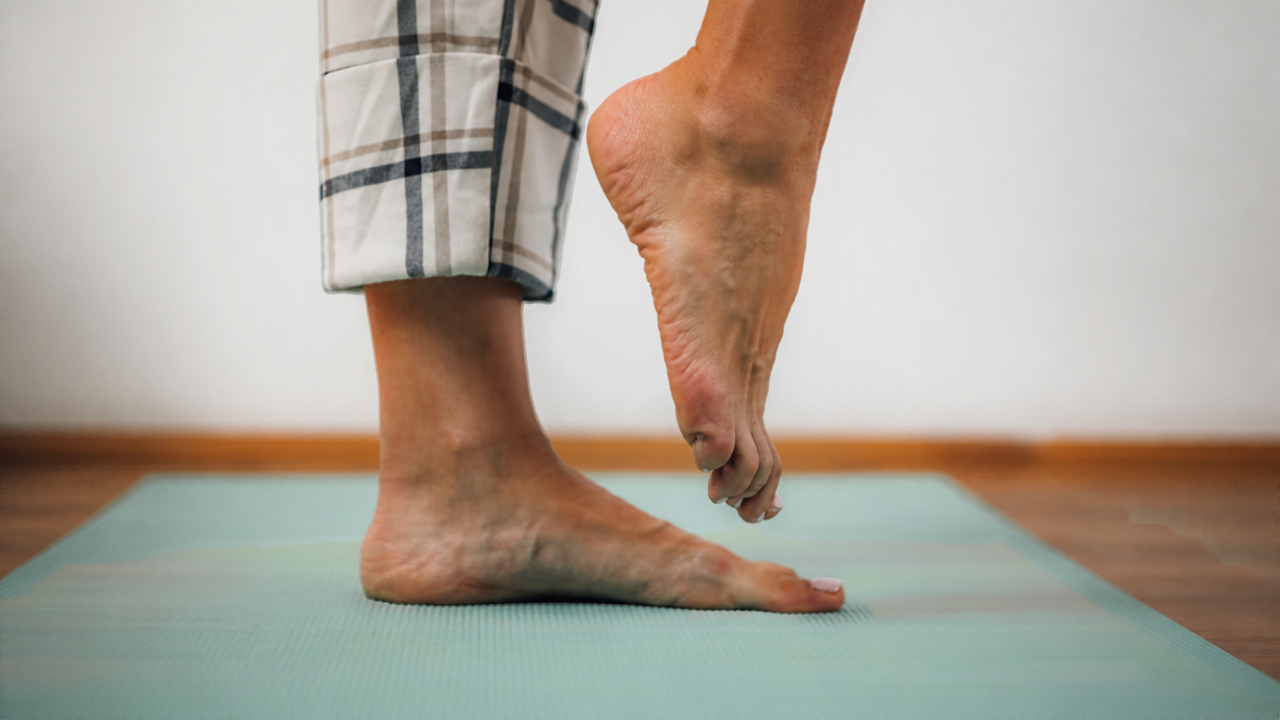
Exploring the science of balance, the nervous system and the benefits of everyday movement.
Originally published in 2021 | Written by Hayley Winter
In this blog, I explore why including a simple everyday balance challenge is important for your brain and everyday movements.
According to the World Health Organization (WHO), falls are the second leading cause of unintentional injury deaths worldwide.
A shocking statistic, and one that reminds us of the importance of maintaining our balance as we move through life.
A YSS favourite, Dr Michael Mosley, referred to this in his podcast series, Just One Thing. He said:
“Our balance is far worse now than it used to be. Having a more sedentary lifestyle comes at a cost - and that cost is a failure of balance.”
Balancing Act: The Science of Staying Upright
In our Yoga Biomechanics teaching, we explore the relationship between gravity, the ground and the body's ability to maintain balance.
Standing might appear effortless, but it's a remarkably complex process.
Our bodies are constantly making small adjustments to keep our centre of mass over our base of support.
These adjustments involve communication between the nervous system, muscles, joints and sensory systems.
Vision helps us understand where we are in relation to our surroundings.
The vestibular system in the inner ear provides information about head movement and orientation.
And proprioception helps us sense the position and movement of our bodies.
Together, these systems allow us to respond to changes in position and maintain balance.
It's a wonderful example of how much is happening beneath the surface of an apparently simple movement.
Feet of Coordination
Dr Mosley described balancing as a feat of coordination.
And I love the idea that it's also a feet of coordination!
Our feet are the interface between the earth and the body, providing essential sensory information from the ground.
This information travels through the nervous system, helping the brain organise movement and respond to changes in balance.
The body continually makes adjustments to maintain its centre of mass over its base of support (BOS).
How quickly we can regain balance depends on how effectively the nervous system, muscles and joints work together to respond and reorganise our movement.
As yoga teachers, it's important to introduce activities that challenge balance and encourage responsive movement, helping our students improve their functional everyday movements.
It's an approach we've successfully used with athletes. And as we're all human athletes, this type of training is valuable both on and off the yoga mat.
A Wobble a Day Keeps the Brain at Play
Dr Mosley said:
“The brain's balance system has an incredible capacity to compensate by making new nerve connections. It is the plasticity of our brains that enables us to stay upright beyond our 40's, and gives us the potential to keep improving our balance even if we feel like we've succumbed to a life of unavoidable stumbles. The trick is to keep wobbling.”
Every time we wobble without falling, the body makes small adjustments to help us regain balance.
Proprioceptive receptors in our muscles and joints provide sensory information to the nervous system, helping us organise the body and remain upright.
And here's where things get interesting.
Regularly challenging our balance encourages the nervous system to adapt through practice. This capacity for change is known as neuroplasticity.
Combining balance challenges with breathing awareness in yoga offers another opportunity to explore how the body responds and adapts.
The approach that both Dr Mosley and YSS recommend is to mix up your daily routine and yoga practice by including different ways to SAFELY do something as simple as standing on one leg.
As Dr Mosley put it, practicing standing on one leg gives your brain another opportunity to adapt.
Take the Wobble Test
Here's a simple balance challenge to explore. Keep a record of your results and see how your balance develops with regular practice.
Step 1: Eyes Open
Stand with your feet hip-width apart. Make sure you're close to a sturdy wall, kitchen counter or something stable to hold on to if you lose your balance.
The intention here is to practice this SAFELY as you prepare to stand on one leg.
Step 2: Find Your Balance
Stand on the leg you think is your strongest.
Time yourself, breathe and find a spot to focus on.
Observe the quality of your wobble and the sensations in your foot and ankle.
Don't push it. It's not a competition!
Make a note of the date, which leg you're standing on and how long you can maintain your balance before putting your foot down.
And don't be hard on yourself. This is how we begin to build sustainable balance and stability. :)
Do the same on the other side.
Step 3: Eyes Closed
Once you've explored balancing on both legs with your eyes open, there's another interesting challenge to consider.
Closing your eyes removes visual information, making balance considerably more difficult.
Important: Don't attempt an unsupported eyes-closed single-leg balance test at home. This progression is best explored with appropriate supervision and a stable support immediately available, particularly if you have any concerns about your balance.
Results: What Did You Notice?
Keep a record of your results.
Notice the differences between your left and right sides.
If you've explored the eyes-closed variation safely under supervision, compare it with your eyes-open experience.
The difference highlights just how important vision is to our sense of balance.
Find a way to practice and play every day. Keep going!
What Does the Research Tell Us?
Here's where the science becomes particularly interesting.
Researchers have explored whether something as simple as standing on one leg might provide useful information about our wider health.
And some of the findings are quite surprising.
Important: With Your Eyes Open
A balance challenge: If it's comfortable and safe for you, work towards maintaining your balance on one leg for up to one minute.
There's no need to force the duration. Build your confidence and ability gradually.
The Japanese Study
A Japanese study reported in the BMJ in 2014 investigated the relationship between single-leg standing ability and changes in the brain.
Researchers found that people who struggled to balance on one leg for 20 seconds were more likely to show signs of cerebral small-vessel disease, including small, previously unnoticed changes visible on brain scans.
The findings also suggested an association between poorer balance and reduced cognitive performance.
Alarming? Potentially. But let's maintain perspective.
The study identified an association. It didn't establish that struggling to balance for 20 seconds means someone will have a stroke.
There are many factors to consider, including age and existing health conditions.
Nevertheless, it's an interesting reminder that balance involves much more than our feet and ankles.
Important: With Your Eyes Closed
The Medical Research Council Study
Another fascinating piece of research comes from the UK's Medical Research Council (MRC).
In a 2014 study published in the BMJ, researchers examined the relationship between physical capability in middle age and subsequent health outcomes.
The study involved 2,766 people whose physical capabilities were assessed at age 53.
Participants completed three physical tests, including a single-leg balance assessment with their eyes closed, under supervised conditions.
Researchers then examined mortality over the following 13 years, up to age 66.
The findings showed that people with poorer physical capability, including poorer balance performance, had higher mortality rates than those who performed better.
The researchers also found that being unable to complete the physical tests was associated with higher mortality.
Again, these findings need to be understood in context.
They don't mean that struggling with an eyes-closed balance test causes poor health or that a particular balance time can predict how long someone will live.
But they do suggest that simple physical assessments may provide useful information about our overall health and physical function.
And that's something worth paying attention to.
Your Wobble Progression
Here's where the fun begins!
Find ways to introduce a little safe wobbling into your everyday routine.
Practise standing on one leg beside the kitchen counter, explore gentle weight shifts or introduce different balance challenges into your yoga practice.
Keep a record of your progress.
Notice how your feet respond, how your body adjusts and how your confidence changes.
And remember, the aim isn't to eliminate every wobble.
It's to give your nervous system opportunities to practise responding to the challenges of balance.
As yoga teachers, we can bring this understanding into our classes, helping students develop greater awareness of how their bodies organise movement.
Sometimes the simplest things can tell us the most.
A wobble a day keeps the brain at play.
I'd love to hear how you've introduced a little wobble into your everyday activities or yoga practice.
