Breathing for Tennis: Exploring Breath Awareness On and Off the Court
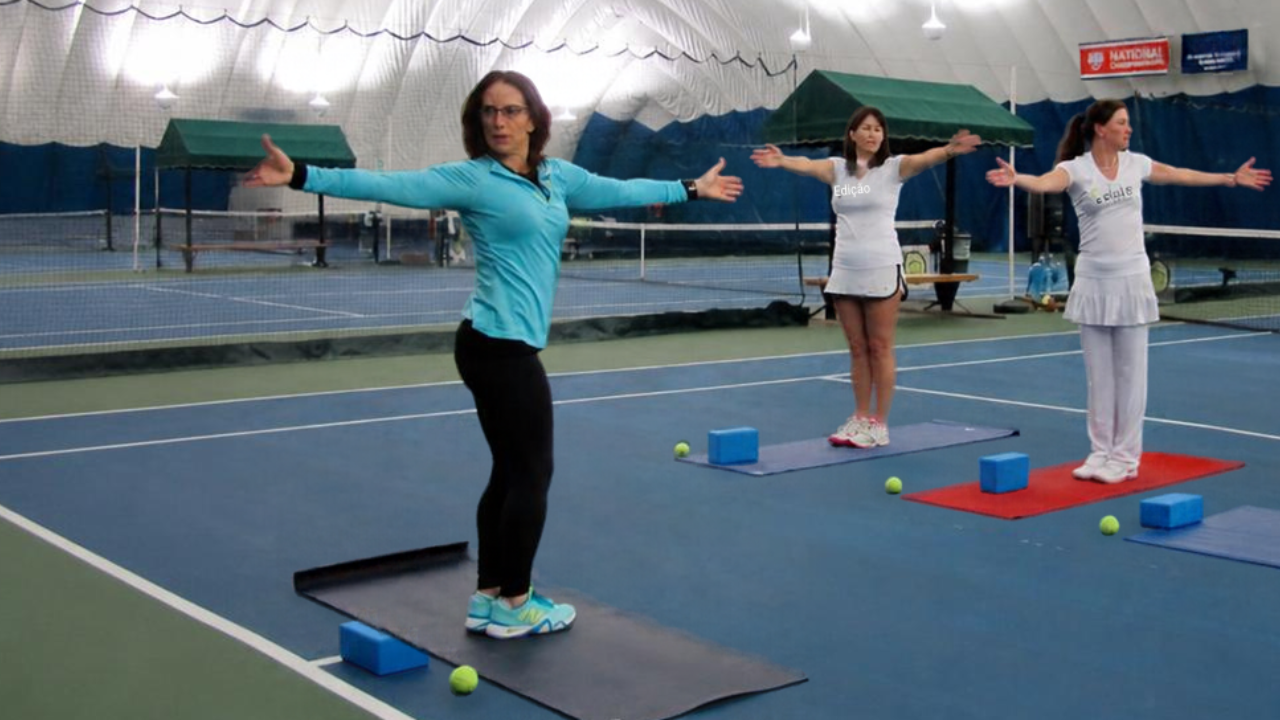
Originally published 2018 · Written by Advanced Yoga Sports Coach, Bonnie Strati
Editor's Note | Revisiting Breath Awareness in Tennis
When Bonnie Strati wrote this article in 2018, she was exploring how yoga breathing practices might help tennis players become more aware of their breathing, both during training and between points on the court.
Breathing remains an essential area of study in sports science, particularly in relation to physiological regulation, attention and individual responses to exercise.
We've revisited Bonnie's article to clarify some of the scientific explanations and refine the practical instructions, while preserving her original teaching ideas and conversational style.
We've all been breathing since the moment we were born.
We take our first breath when we arrive in the world, and our breathing continues throughout our lives, usually without us giving it much thought.
An adult takes thousands of breaths every day, with the number changing according to activity, health and individual breathing patterns.
Yet how often do we stop to notice the way we breathe?
Learning to become more aware of your breathing may offer useful opportunities to explore how you respond to the physical and psychological demands of tennis, both on and off the court.
And it all begins with bringing awareness to your own breathing patterns.
Breathing and the Demands of Tennis
A tennis match involves repeated bursts of high-intensity movement, interspersed with short recovery periods between points and longer breaks between games and sets.
Depending on the level of play, a match can last well over an hour, placing considerable demands on a player's physical endurance and ability to recover between rallies.
Tennis requires contributions from both the anaerobic and aerobic energy systems.
The anaerobic systems help supply energy during short, explosive movements, such as sprinting across the court to reach a ball.
The aerobic system supports sustained activity over the course of a match and plays an important role in recovery between repeated efforts.
Alongside physical conditioning, players also need to manage the psychological demands of competition.
This is where exploring your breathing patterns may be helpful.
Becoming more aware of how you breathe, particularly during periods of rest, can provide an opportunity to notice tension, recognize changes in your breathing and experiment with ways of settling yourself before the next point.
Breathing and the Nervous System
Breathing is closely connected with the autonomic nervous system, which helps regulate many of the body's automatic functions.
Two important components are the sympathetic and parasympathetic nervous systems.
The sympathetic nervous system is involved in preparing the body to respond to physical and psychological demands.
The parasympathetic nervous system contributes to processes associated with rest, digestion and recovery.
Both systems are active to varying degrees throughout the day, continually responding to what the body needs.
Breathing patterns can influence aspects of this regulation.
For example, comfortable, slower breathing may help some people reduce feelings of physiological arousal and experience a greater sense of calm.
However, the response is individual. Deliberately changing the breath doesn't always feel relaxing, and for some people, focusing closely on breathing can increase discomfort or anxiety.
The aim is therefore to explore your breathing with curiosity rather than trying to force a particular response.
Understanding the Breathing Muscles
The diaphragm is the primary muscle involved in breathing.
As we inhale, the diaphragm contracts and moves downwards, contributing to changes in pressure that allow air to enter the lungs.
The ribcage also moves during breathing, supported by muscles between the ribs and, when breathing demands increase, additional muscles around the chest, neck and shoulders.
The abdominal muscles contribute particularly during more forceful exhalation and help coordinate the movement of the trunk.
During exercise, breathing becomes faster and deeper as the body responds to increased demands.
Tension, posture and movement can influence how comfortable breathing feels, although the relationship is more complex than simply having tight or relaxed muscles.
Gentle movements such as Cat-Cow, shoulder rolls and side bends can provide an opportunity to explore movement through the spine, shoulders and ribcage.
These movements may help you become more aware of how your chest and trunk move as you breathe.
And that brings us to our first exploration.
Discover How You Breathe
This simple practice is about observation.
There is no perfect way to breathe, and there's no need to change anything immediately.
- Sit comfortably in a chair with your feet resting on the floor. If you prefer, you can lie down.
- Place your right hand on your upper chest and your left hand on your lower ribs or abdomen.
- Allow your breathing to continue naturally. You can breathe through your nose or mouth, whichever feels most comfortable.
- Notice where you feel movement beneath your hands. Does your chest move? Can you feel movement around your lower ribs or abdomen?
- If it feels comfortable, experiment with allowing your exhale to become a little slower or longer. Avoid forcing the breath or trying to take unusually deep breaths.
- Notice how you respond. Does the change feel comfortable? Do you become more aware of tension or movement?
- Continue for a minute or two, or for as long as the practice feels comfortable.
Sometimes bringing awareness to breathing can create anxiety in some people. Breath awareness can feel stimulating as well as calming.
If this happens, return to your natural breathing pattern, open your eyes and bring your attention back to your surroundings.
You might like to think of the exhale as an opportunity to soften unnecessary tension, rather than something you have to control.
Remember, this practice is about awareness, not perfection.
Be kind to yourself and practice being an observer.
Exploring Ribcage Movement with a Theraband
This technique uses gentle tactile feedback to help you notice how your ribcage moves during breathing.
A Theraband is a thin elastic band commonly used for exercise and therapeutic movements. You can also use a soft scarf or a length of fabric.
The purpose of this exercise is to explore ribcage expansion, rather than to increase your anatomical lung capacity.
- Sit comfortably in a chair with your feet on the floor. Alternatively, sit on the floor with your back supported against a wall.
- Place a soft band or scarf around your lower ribcage, keeping the ends in your hands. The band should rest gently against your body without restricting your breathing. Do not tie it tightly around your ribs.
- Allow your breathing to flow naturally.
- As you inhale, notice whether you can feel the ribcage gently expanding into the band.
- Explore the movement around the front, sides and back of your ribcage.
- As you exhale, notice how the ribcage moves back towards its resting position.
- Continue for several comfortable breaths, allowing the movement to happen naturally.
There's no need to pull against the band or exaggerate the breath.
The band simply provides another way of noticing movement that might otherwise be difficult to feel.
As with any breathing practice, stop if you experience dizziness, discomfort or breathlessness.
With each session, you may begin to develop a greater awareness of how your ribcage moves during breathing.
Bringing Your Breath onto the Court
So how might you apply this awareness during a tennis match?
Between points, players have a brief opportunity to reset before the next rally.
This can be a useful moment to notice your breathing.
After a demanding point, your breathing will naturally be faster as your body responds to the physical effort.
Rather than immediately trying to slow it down, allow yourself a moment to recover.
As your breathing begins to settle, you might experiment with one or two comfortable, unforced breaths.
If it feels natural, allow the exhale to become slightly longer.
For some players, this may provide a helpful way to settle their attention and prepare for the next point.
The aim isn't to force your heart rate down or guarantee faster physical recovery.
It's to develop a simple routine that helps you notice how you're responding and prepare yourself for what comes next.
You may also find it helpful to combine breathing awareness with a familiar between-point routine, such as adjusting your racket strings, walking back into position or briefly focusing on your next tactical decision.
Over time, you can explore which approaches feel most useful for you.
A Final Thought
Breathing happens automatically, but we also have the ability to consciously influence aspects of how we breathe.
That's what makes breath awareness such an interesting practice.
For tennis players, exploring breathing patterns can become another way of understanding the relationship between physical effort, attention and individual responses to competition.
Most importantly, have fun exploring.
Be curious about what you notice, allow your breathing to respond naturally to the demands of the moment and remember to exhale!
About Bonnie Strati
At the time of writing in 2018, Bonnie Strati was Director of Operations for the Institute of Yoga Sports Science® and an Advanced Yoga Sports Coach™. She was also a 200-hour Registered Yoga Teacher and held a Level 2 Nutrition Coaching Certificate from Precision Nutrition.
Where Is Bonnie Today?
Since writing this article, Bonnie has continued her professional journey and become an author.
You can learn more about Bonnie, her writing and her current work on her website.
Interested in Teaching Yoga to Athletes?
Breathing awareness is one of many areas yoga teachers can explore when adapting their teaching to the needs of athletes.
The Yoga for Athletes 40-Hour Online Course from the Institute of Yoga Sports Science® brings together traditional yoga practices with contemporary sports science, helping teachers develop a more informed approach to working within sport.
